We all seek happiness. People who take up a spiritual or religious practice often do so due to a desire for more depth and substance in their material life. Yoga and yoga philosophy can bring perspective and give us tools to improve our lives.
In my experience, lasting happiness is not possible with poor health. In this article, I aim to build a bridge between what yoga philosophy teaches us about happiness, and the tools yoga and Ayurveda give us for complete health.
As yoga is non-sectarian, its teachings can be applied by anyone, no matter their religion, as long as they have an open and curious mind.
Pleasure or happiness?
When I ask my classes what happiness is, they give examples of things that make them feel happy. The happy times they mention often include:
- spending time with family
- taking a walk in nature
- lying on the beach
- dancing
- listening to music
- traveling
All these ideas of happiness are temporary.
These activities are actually pleasures.
In the beginning a pleasure gives us a feeling of happiness, but it usually fades relatively quickly and easily. Consider this example: if you are very hungry and sit down to eat a big pizza, the first slice gives you the most pleasure. As you start to get full the last slices don’t give you the same pleasure.
Pleasure happens when our senses are temporarily fulfilled.
When pleasure fades, we look for the next source of pleasure. Pleasure is not a bad thing, as long as you recognize it as temporary. Enjoy the pleasures in your life but do not get so attached to them that they disturb your physical or mental balance.
Happiness is deeper, and occurs when our expectations are met in a satisfying way over a prolonged period of time. In our human quest for happiness, we often make the mistake of confusing temporary pleasures with more permanent and fulfilling happiness.
The six pillars of happiness
In my experience, the expectations people hold for their lives can be divided into six groups which are universal. I describe these as the six pillars of happiness, since meeting our expectations in these areas will create happiness in our lives.
This concept is introduced in Six Pillars of a Happy Life, which explores building a life vision based on six pillars:
- Health
- Career /productivity
- Relationships
- Leisure / fun
- Spirituality
- Lifestyle
This order is arbitrary – all these pillars are equally important and our expectations in these areas must be fulfilled to a certain extent if we want to experience a relatively constant level of happiness.
Discover yoga philosophy principles to boost your happiness

Get free access to a life-changing series of 6 webinars with Arhanta Yoga founder Ram Jain
The First Pillar of Happiness: Health
We all know from personal experience that if our health is compromised it is very challenging to experience a desired level of happiness, even if all the other five pillars fully meet our expectations. In my experience, even though the six pillars are equally important… the pillar of health holds just a little more weight.
What is health in light of yogic philosophy?
Health is often mistakenly understood to refer only to the body. But just like the skin of a mango will rot if the seed or pulp are rotten, so will our physical body suffer if our inner bodies (energy body and spiritual body) are unhealthy.
This concept of the three bodies lies at the foundation of complete health. We are much more than only our physical body. In fact, every living being is made up of three bodies.
1. Physical body
The physical body is made up of the five elements: earth (prithvi), water (jal), fire (agani), air (vaayu) and ether (akasha).
2. Energy body / astral body
Every living being has an astral or energy body. It is made up of 19 elements:
Five organs of action (Karma indriyas)
- Vak (action of speech)
- Pani (action of upper extremities)
- Pada (action of lower extremities)
- Upashtam (action of genitals)
- Payu (action of excretion)
Five pranas (Panch vayu)
- Udana
- Prana
- Samana
- Apana
- Vyana
(The five pranas are explained further in Prana Demystified.)
Five senses of knowledge (Gyan indriyas)
- Tvak (to feel)
- Jivha (to taste)
- Grahna (to smell)
- Shotra (to hear)
- Chakshu (to see)
Four elements of antahkarana / inner instruments:
- Mind
- Intellect
- Subconscious
- Ego
3. Spiritual / causal body
The causal body is the seed body. This body continues through all the lives. The causal body stores subtle impressions in the form of karma from everything that has happened to you in this life and past lives. The causal body determines the development of the physical and astral bodies in the next birth. At the time of death, the causal and astral bodies, which remain together, separate from the physical body. The elements of the spiritual body are:
- Soul
- Karma account
- Free will
- Samskaras
Yogic Strategies for Holistic Health
Yoga recognizes the presence of all three bodies, and offers practices to balance them, to accomplish overall (holistic) health.
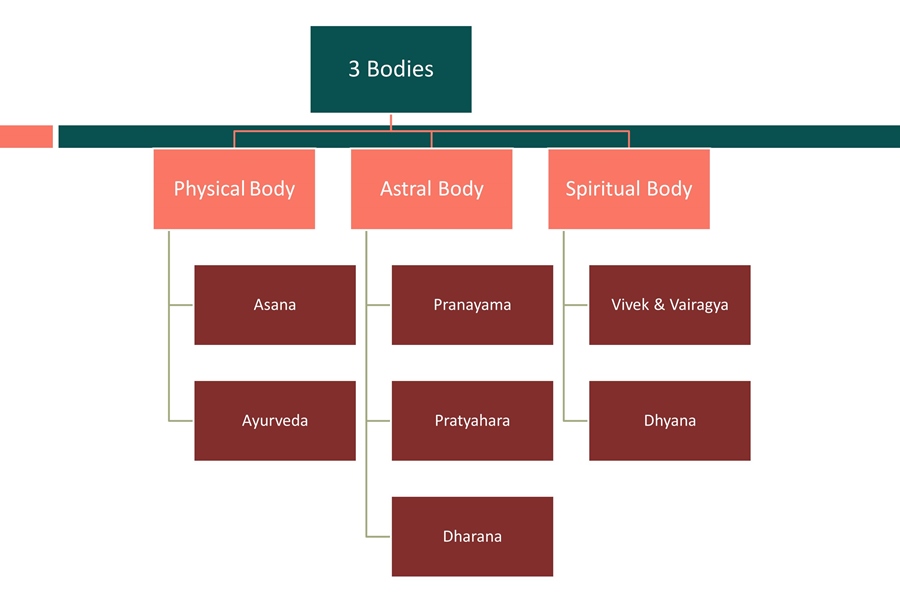
Physical body holistic health through yoga asana and Ayurveda
The practice of yoga asanas contributes to the health of the physical body by:
- purifying and detoxifying the entire body, for example by improving blood and lymph circulation.
- stimulating and re-balancing the endocrine (hormonal) system